Today I returned to UTP.
Returning to work after a vacation always a shock. And after an idyllic one such as the one I just had with David, it's even more of a shock.
It was great seeing friends.
It was great catching up.
But a big piece of my heart went back with David, back to Oakland if not San Francisco, and it's hard to concentrate when that happens.
Which is probably why I didn't post yesterday.
Today, the ache is still there, but it's more manageable. And there's a lot to do to get ready to go off to Chiriqui and the Ngobe-Bugle people with Lydia on Thursday. So, putting one foot in front of the other, and one thought and one word and so on, I will prepare and go and learn.
My heart will always be with David, but not all of it. Part of it is right here with me, helping me have the strength and courage to do what needs to be done.
Ciao!
Tuesday, June 3, 2014
Sunday, June 1, 2014
Boo hoo!
David left to return home today.
Boo hoo!
I miss him already!
So I spent some time to search the web to see if there is anything about tapirs spraying.
And it turns out there is.
Apparently, others have also been sprayed - some on video even. You can check them out on YouTube for yourself, by searching on "Tapir pee" - just be aware that there are a number of other tapir videos there that might not be acceptable to your children. Or your parents. Or maybe even you.
Boo hoo!
I miss him already!
So I spent some time to search the web to see if there is anything about tapirs spraying.
And it turns out there is.
![]() |
| (from http://imgur.com/Bjmi7) |
Saturday, May 31, 2014
Golden frogs and golden showers
Today was a fabulous day - even though it's David's last day in Panama <sniffle>
Rogelio took us to El Valle de Anton. He picked us up at O'dark:30 (aka 8 am), still in his cast since the doctor delayed taking it off by a week. He was understandably annoyed.
We sped off on the Pan American Highway, crossing the Centennial Bridge and then heading off into the countryside. There were a lot of billboards that are now "Disponible" (for rent) - recently vacated by the political parties, although there are also a lot of flags and other signs that remain. It seemed from an unscientific view that many - even most - of these were for Jose Domingo Arias of the Cambio Democrático, or CD Party. This is the party that would have been heir to the current government and that even included the current President's wife as Arias' Vice Presidential running mate. I mentioned this to Rogelio who said that complaints about this had recently aired on TV.
I hadn't really noticed how many new developments there are just outside Panama City - or how many properties are for sale even without new development. It's kind of insane. In other places - like Colorado for instance - development has spoiled many special places and homes have often remained vacant or unsold. It is too bad that this appears to be happening here in Panama, although it is certainly understandable that people want to live in these lovely places.
We turned off on the road to El Valle and twisted and turned our way up to the lip of the ancient (and extinct) volcano that encircles El Valle.
It claims to be the only inhabited volcano and it is the only remaining place that the incredibly rare (actually critically endangered) Panamanian Golden Frogs live. Or lived.
Although Golden Frogs have extremely toxic skin to protect themselves, they are threatened by both habitat destruction and, more importantly, by a fungal infection that has all but wiped the species out in the wild. They are now kept in captivity to protect them from this fungus. Unfortunately, they cannot be reintroduced into the wild at this time because there is no cure for the fungus that remains rampant in the wild.
Luckily, captive populations, including in El Valle, are thriving. The San Diego zoo also has a Golden Frog Conservation Program which both breeds the amphibians and also sends money to Panama to assist them in their conservation efforts. In addition, the Houston Zoo has provided money to fund the El Valle Amphibian Conservation Center. We were able to see this elusive animal at El Nispero Zoo and Botanical Garden.
Other frogs and toads (actually the Golden "Frog" is a toad) included these fellows:


The center also has a number of plants for sale. There were many that were simply gorgeous.
The organization uses the proceeds from the sale of these plants to help support that entire enterprise.

In addition to plants for sale, the organization also grafts different plants together to create interesting and unusual results.
There are also many birds. I quickly lost count of them and forgot their names but I took photos for my birding friends. For instance, look at the following beauties.
Many, even most of them are not native to Panama, instead coming from China, like the Golden Pheasant on the right, India, like the peacocks - here in full display, although in neither case did their display appear to be working for them as the peahens simply milled around them, totally ignoring them, and Africa, like the ostrich below.


The parrots and hawks were native to Panama, however. There were also many other lovely lorikeets and parrots, including Scarlet Macaws and Blue & Gold Macaws, who were too shy for photos.
And then there were the animals. Monkeys and an ocelot (who insisted on continuing to snooze while whipping his tail in annoyance at the kids' noise) and others.

And then there was the tapir.
As we stood admiring the tapir, it came over as if to greet us. But it quickly turned its back on us and sprayed David. Whether it was threatened by him, or jealous of him (although I'm not sure that says anything good about either of us) or marking him as his own, or something else, he gave David a rather stinky "Golden Shower"!
Shocked, as you can imagine, but thinking quickly (of course!), David ripped off the sprayed shirt so it would not smell up the rest of his clothes. The guide told him to wash it in the small waterfall leading from the Wishing Pond. I'm pretty sure we both were wishing that the tapir had remained uninterested and had quietly stayed on the other side of the cage. I would gladly have foregone a photo to avoid this rather nasty experience.
There were still a few opportunities for photos of us and of the guide.
We bid adieu to the guide and headed to the Craft Market. There, we saw (but resisted) many interesting and beautiful things. And many uninteresting and ugly things too. We were well able to resist because we are definitely "Over-Stuffed" at home. It was good to remember, as David mentioned to me (and as I had already thought), we had just gotten rid of many similar things - like wooden bowls and platters and tchotchkes.
There were some local pastries and candies however. David got some yummy cookies and I got milk candies for my colleagues at work. It started to sprinkle just as we got back into the car.
And then it started to rain in earnest. Big, fat drops fell increasingly fast and, after a few minutes of driving around the area, we decided to head homewards.
David, who slept very little last night, fell asleep almost immediately as the car swayed from side to side as Rogelio drove up to and along the rim of the volcano and then down the other side.
When we arrived home, David washed his shirt by hand, and then we washed it along with the regular clothes. And luckily, the entire load didn't become "Tapir-ized"!
Rogelio took us to El Valle de Anton. He picked us up at O'dark:30 (aka 8 am), still in his cast since the doctor delayed taking it off by a week. He was understandably annoyed.
We sped off on the Pan American Highway, crossing the Centennial Bridge and then heading off into the countryside. There were a lot of billboards that are now "Disponible" (for rent) - recently vacated by the political parties, although there are also a lot of flags and other signs that remain. It seemed from an unscientific view that many - even most - of these were for Jose Domingo Arias of the Cambio Democrático, or CD Party. This is the party that would have been heir to the current government and that even included the current President's wife as Arias' Vice Presidential running mate. I mentioned this to Rogelio who said that complaints about this had recently aired on TV.
I hadn't really noticed how many new developments there are just outside Panama City - or how many properties are for sale even without new development. It's kind of insane. In other places - like Colorado for instance - development has spoiled many special places and homes have often remained vacant or unsold. It is too bad that this appears to be happening here in Panama, although it is certainly understandable that people want to live in these lovely places.
| This way! |
| Although it is hard to see, the yellowish blob on the right is a Golden Frog |
Luckily, captive populations, including in El Valle, are thriving. The San Diego zoo also has a Golden Frog Conservation Program which both breeds the amphibians and also sends money to Panama to assist them in their conservation efforts. In addition, the Houston Zoo has provided money to fund the El Valle Amphibian Conservation Center. We were able to see this elusive animal at El Nispero Zoo and Botanical Garden.
Other frogs and toads (actually the Golden "Frog" is a toad) included these fellows:
| This sleepy fellow was sitting on a leaf. Many of the others were hidden or in places that didn't lend themselves to photography. |

The center also has a number of plants for sale. There were many that were simply gorgeous.
The organization uses the proceeds from the sale of these plants to help support that entire enterprise.
In addition to plants for sale, the organization also grafts different plants together to create interesting and unusual results.
There are also many birds. I quickly lost count of them and forgot their names but I took photos for my birding friends. For instance, look at the following beauties.


| OK, he's not exactly a beauty, but he sure was friendly |
And then there were the animals. Monkeys and an ocelot (who insisted on continuing to snooze while whipping his tail in annoyance at the kids' noise) and others.

And then there was the tapir.
As we stood admiring the tapir, it came over as if to greet us. But it quickly turned its back on us and sprayed David. Whether it was threatened by him, or jealous of him (although I'm not sure that says anything good about either of us) or marking him as his own, or something else, he gave David a rather stinky "Golden Shower"!
Shocked, as you can imagine, but thinking quickly (of course!), David ripped off the sprayed shirt so it would not smell up the rest of his clothes. The guide told him to wash it in the small waterfall leading from the Wishing Pond. I'm pretty sure we both were wishing that the tapir had remained uninterested and had quietly stayed on the other side of the cage. I would gladly have foregone a photo to avoid this rather nasty experience.
There were still a few opportunities for photos of us and of the guide.
There were some local pastries and candies however. David got some yummy cookies and I got milk candies for my colleagues at work. It started to sprinkle just as we got back into the car.
And then it started to rain in earnest. Big, fat drops fell increasingly fast and, after a few minutes of driving around the area, we decided to head homewards.
David, who slept very little last night, fell asleep almost immediately as the car swayed from side to side as Rogelio drove up to and along the rim of the volcano and then down the other side.
When we arrived home, David washed his shirt by hand, and then we washed it along with the regular clothes. And luckily, the entire load didn't become "Tapir-ized"!
Videos from Panama (mostly rain!)
Leaving Ukupseni Village on Thursday afternoon by boat gives an impression of the size of the village.
About 1/3 of the current island is built on landfill because the Community is running out of room. Children account for over 60% of the current population of roughly 2000. The population can swell to 3000 or more during festivals.
~~~~~~~~~
Rain in Panama City is fierce and this was my first experience of the effects of sudden downpours on the traffic. In the first video, we are heading in one direction, and in the second, we are heading the opposite direction at the same spot so you can see it a bit more dramatically.
These 2 videos were taken during a torrential downpour just as we were leaving the UTP Regional Center in David.
This final video is of our driver, Sr. Sanchez, navigating through David following the heavy downpour recorded above on campus. It was incredibly intense - so intense that it flooded the streets. of David. (Please forgive the early attempt to show the action out the side window!)
Friday, May 30, 2014
More photos from our tour on Sunday
| Casco Viejo and Cinta Costera from Cerra Ancon |
| Downtown from Cerra Ancon |
| Rogelio and David |
![]() |
| Panama's flag on Cerra Ancon |
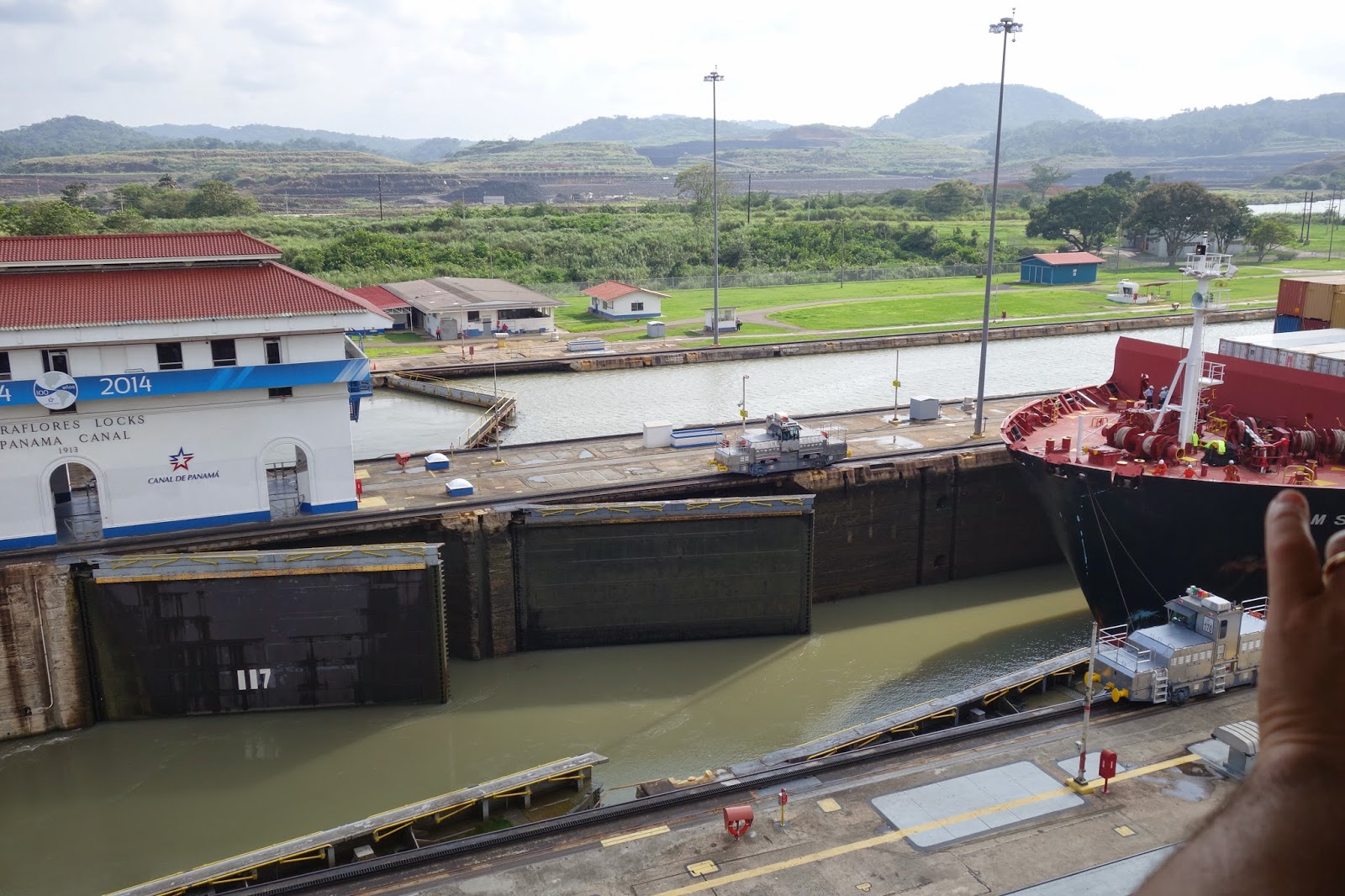
| The Panama Canal locks just starting to open |
|
| Locks are more open |
| Almost open |
| Locks are all open - here comes the ship! |
| The bridge of the ship |
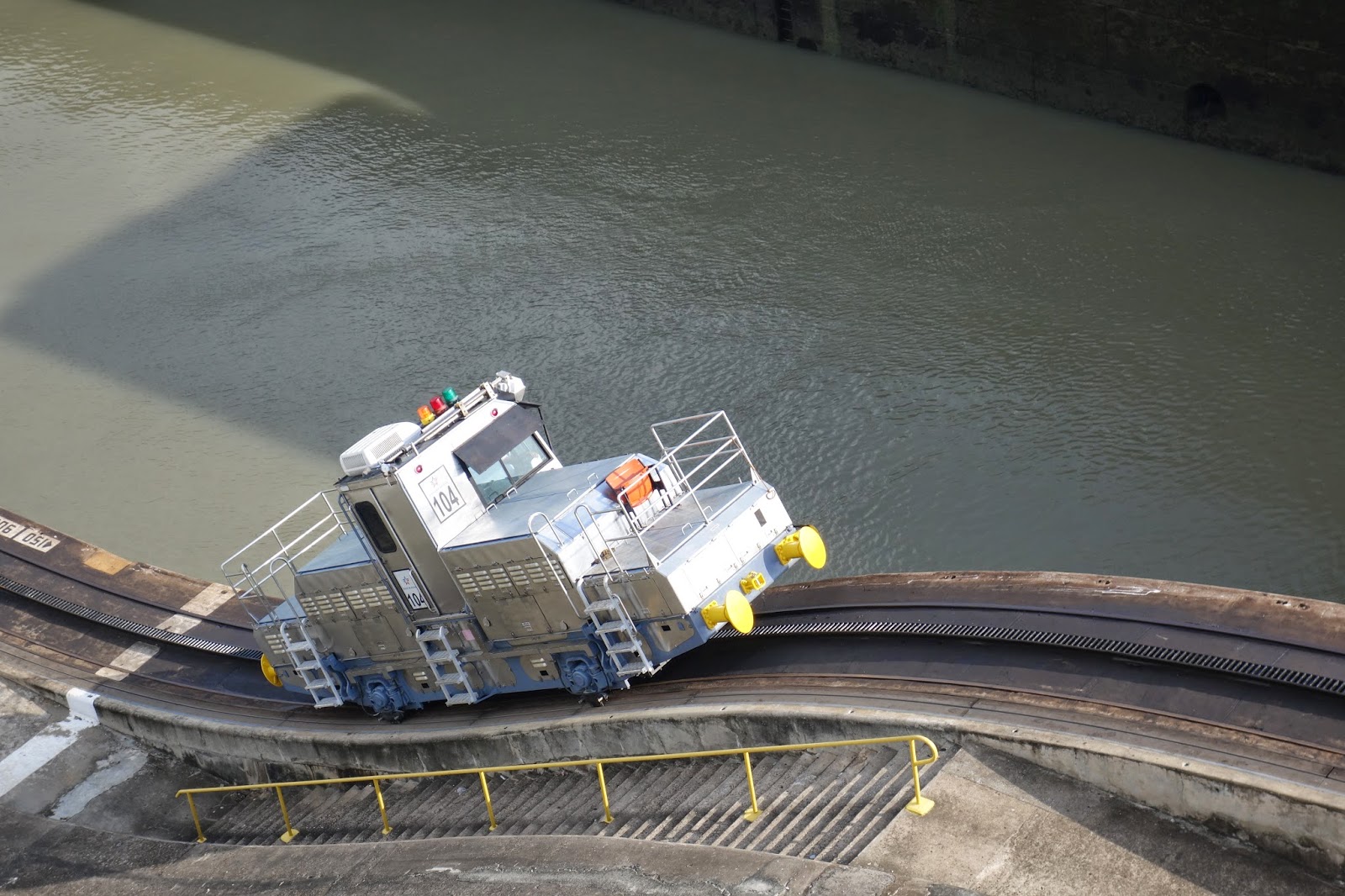
| The mule returning to the top of the locks |
| A tanker transiting |
| Careful: Crocodiles may be present here! |
![]() |
| Boats on the dock on the Causeway |
Molas
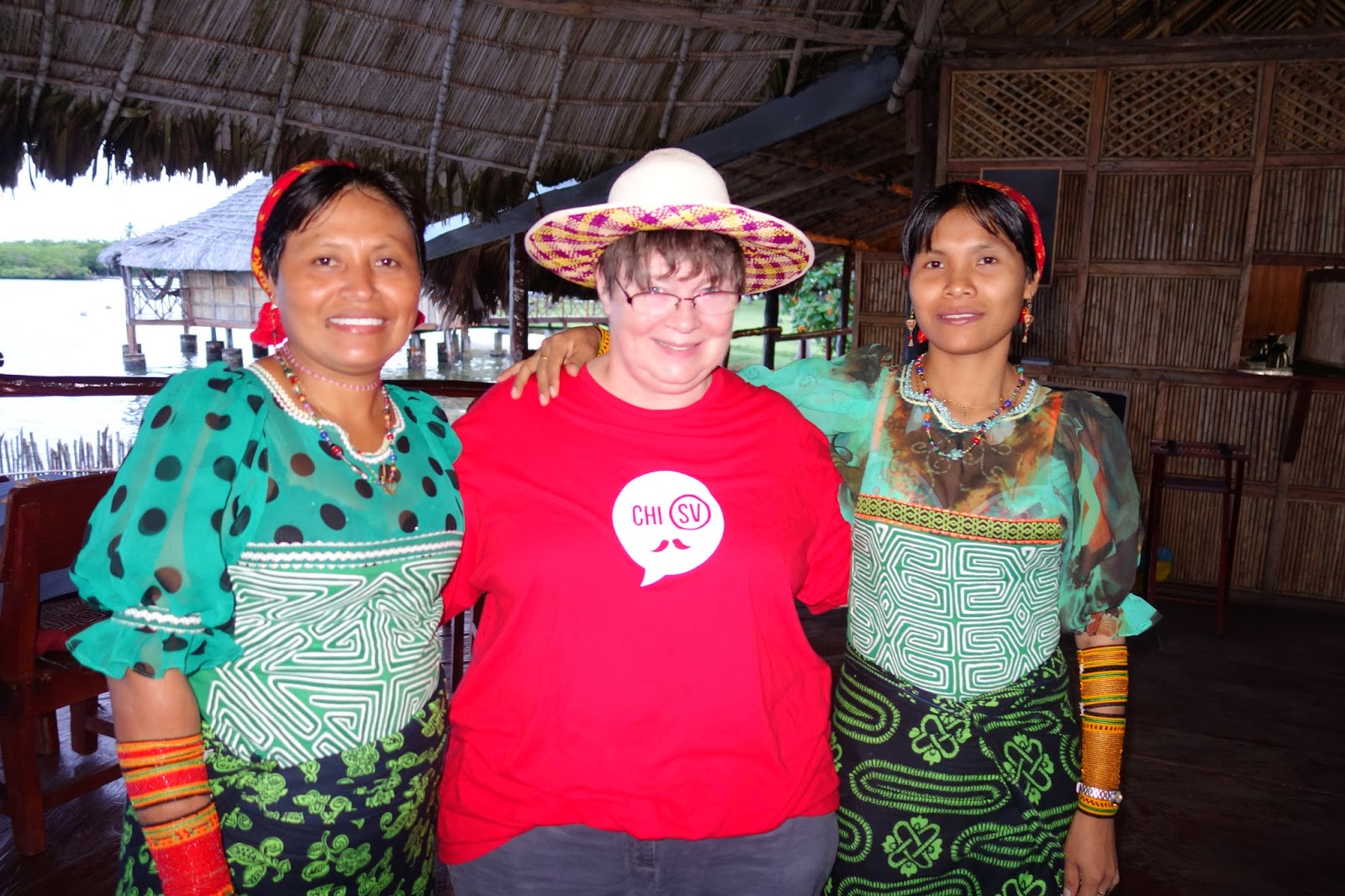
One thing that the Kuna are known for is their molas. They are made by the women and are worn on the fronts and backs of their blouses.
Molas are handmade using reverse appliqué. Layers of cloth are sewn together - as many as 7 in some very complex ones - and then the seamstress creates a design by cutting away parts of each layer and then hand-finishing the seams. The level of skill is astounding. On ours, the stitches are practically invisible. Sometimes, molas also include embroidery.
Originally, they were simply geometric shapes. However now, they include a wide array of designs. It's amazing that every single one we saw was different.
Here are some that we purchased:
![]() |
| Two love birds (for us) |
| We bought this for Elba |
Monday, May 26, 2014
San Blas and the Kuna Yala (Tuesday - Friday)
Some background: The Kuna people live an autonomous area on the northern coast of Panama, called a "Comarca"that includes the San Blas Islands and the adjacent mainland. There are other Comarcas for other indigenous groups including the Ngobe-Bugle in western Chiriqui and Bocas provinces where I visited with Aris and her class (and family), and others for the Embera Wounaan people in the Darien where Americans are warned against going. (The Embassy stressed I was NOT to go there)
These maps show where Kuna Yala is with relation to other parts of Panama (left), and more detail of the area itself (right).
Tuesday long before dawn (4:30ish), David and I headed to Allbrook Airport, which is the domestic airport, to head up to Kuna Yala in a Twin Otter that looked like it had seen many, many similar flights. The airport itself lost power several times while we were waiting to board, which did not inspire confidence, but it was dawn when we left, and the power was back on.
We climbed (literally) into the Twin Otter, buckled up, and sped away. We flew over the UTP campus (I waved at all of you there) We flew over the countryside and quickly crossed the country, which is about 40 miles across, although since we flew diagonally across the country, it was a 150 mile flight. And Loud.
It was a clear day most of the way and we got great views of the jungle from above. Unfortunately, the photos I took didn't come out.
In the last few minutes before landing at the first airport, we entered a cluster of big, billowing, puffy clouds which were lovely (but also made for a very bumpy ride) I'm glad to report that no one needed the "Sic-Sac" pictured to the right. (That can't be said for the flight that came in yesterday - but more on that later)
Our first stop was at the Achutupu airport (shown to the right) There, boxes of food and other goods were unloaded by Kuna women, and one person boarded. David had seen the airstrip from the air and thought that it was abandoned - it definitely felt like we were landing on a remote strip in a very far away place.
We quickly were on our way again. Flying up the coast, we could see the islands below and the Kuna people out fishing in their dugout canoes, some of which had sails.
![]() |
| Kuna Yala in more detail |
![]() |
| Provinces and Comarcas |
These maps show where Kuna Yala is with relation to other parts of Panama (left), and more detail of the area itself (right).
Tuesday long before dawn (4:30ish), David and I headed to Allbrook Airport, which is the domestic airport, to head up to Kuna Yala in a Twin Otter that looked like it had seen many, many similar flights. The airport itself lost power several times while we were waiting to board, which did not inspire confidence, but it was dawn when we left, and the power was back on.
We climbed (literally) into the Twin Otter, buckled up, and sped away. We flew over the UTP campus (I waved at all of you there) We flew over the countryside and quickly crossed the country, which is about 40 miles across, although since we flew diagonally across the country, it was a 150 mile flight. And Loud.
![]() |
| Our plane |
![]() |
| UTP campus (my building is the largest one ) |
![]() |
| Luckily we didn't need this! |
![]() |
| Achutupu airport |
Our first stop was at the Achutupu airport (shown to the right) There, boxes of food and other goods were unloaded by Kuna women, and one person boarded. David had seen the airstrip from the air and thought that it was abandoned - it definitely felt like we were landing on a remote strip in a very far away place.
We quickly were on our way again. Flying up the coast, we could see the islands below and the Kuna people out fishing in their dugout canoes, some of which had sails.
Subscribe to:
Posts (Atom)